A Navier-Stokes-Based Validity Framework for Linear and Nonlinear Transient Pressure-Wave Modeling in Spacecraft Pumped-Fluid Loops
DOI:
https://doi.org/10.55672/hij2026pp46-61Keywords:
Navier-Stokes equations, hydraulic transients, pressure waves, model validity, nonlinear fluid dynamics, spacecraft thermal control, mechanically pumped fluid loopAbstract
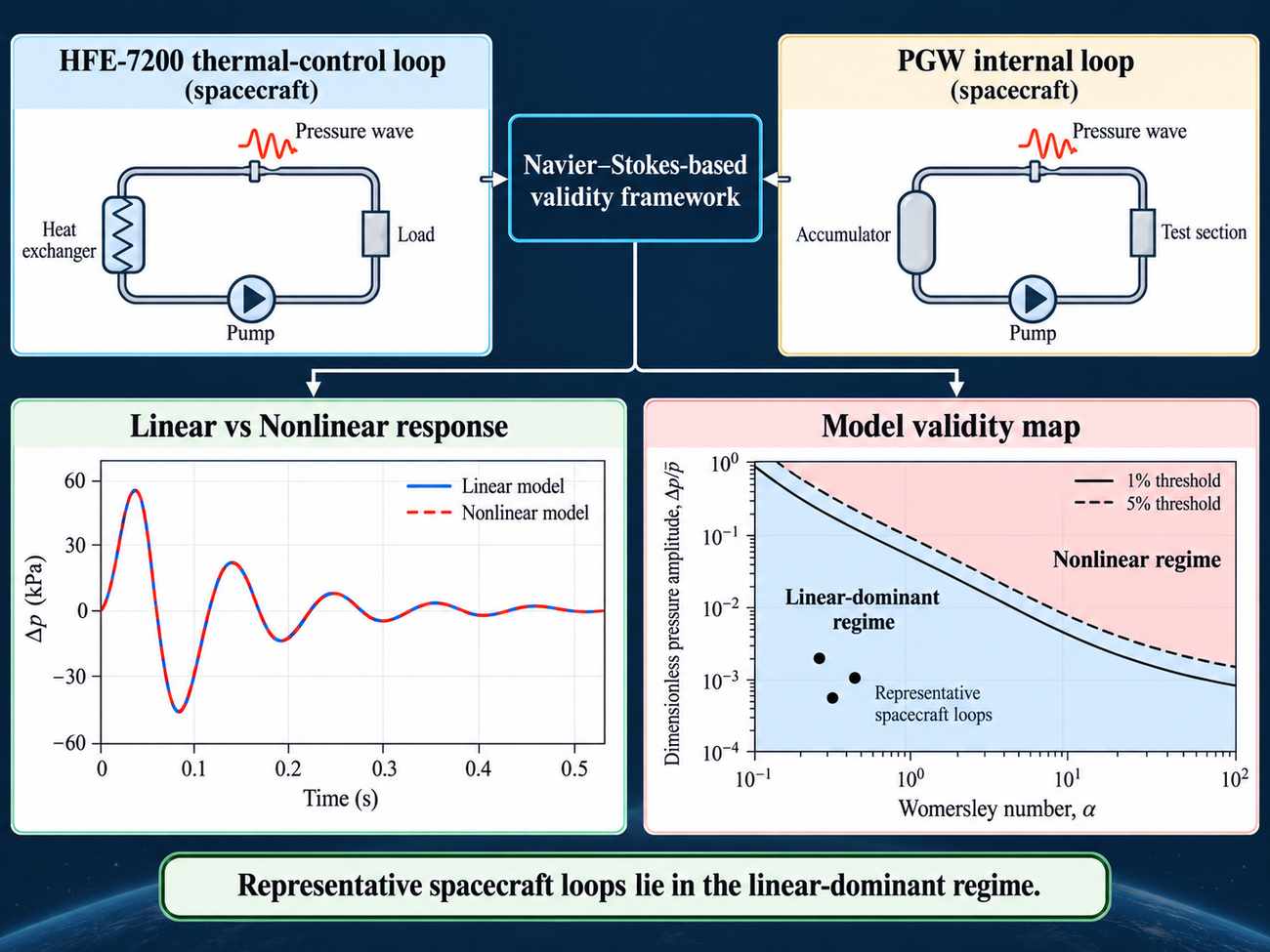
Transient pressure disturbances in spacecraft pumped-fluid loops are commonly represented by linearized one-dimensional models, yet the error introduced by linearization is rarely quantified against a nonlinear formulation derived from the same conservation laws. This study develops a Navier-Stokes-based validity framework for single-phase spacecraft pumped-fluid loops. Mass conservation and axial momentum balance for a slightly compressible Newtonian liquid are reduced to coupled pressure-velocity equations that retain convective inertia and flow-regime-dependent wall friction. A consistent linear model is obtained by perturbation about a nonzero steady circulation state. The equations are solved with fourth-order spatial differencing and classical fourth-order Runge-Kutta integration. Verification against an exact smooth nonlinear characteristic solution gives the designed fourth-order convergence, with relative error decreasing to 2.72×10⁻¹⁰ at 800 grid points, and the nonlinear solution recovers the moving-base linear limit as the acoustic Mach number tends to zero. Two spacecraft-informed applications are examined: a turbulent HFE-7200 external thermal-control loop and a laminar 50/50 propylene-glycol/water internal loop. For a 20% smooth pump disturbance, the global linear-versus-nonlinear pressure discrepancies are 0.0667% and 0.0116%, respectively, with peak transient pressure excursions of approximately 74.8 and 13.6 kPa. Even at the largest tested disturbance amplitude (45%), the discrepancies remain 0.1481% and 0.0260%. A broader dimensionless map shows that errors above 1% require simultaneously larger acoustic Mach number and disturbance amplitude, while the 5% threshold in the tested turbulent family appears only near M ≳ 0.08 with strong forcing. The results show that the consistent linear model is quantitatively sufficient for the representative low-Mach spacecraft loops studied, while the nonlinear formulation provides a verified criterion for identifying conditions under which that simplification ceases to be adequate.
Downloads
Author Biography
Misha Nikouravan, Mechanical Engineering, CentraleSupélec, Université Paris-Saclay, France
https://orcid.org/0000-0003-1976-8848 
References
[1] Y.-G. Lv, Y.-T. Wang, T. Meng, Q.-W. Wang, and W.-X. Chu, "Review on thermal management technologies for electronics in spacecraft environment," Energy Storage and Saving, vol. 3, no. 3, pp. 153-189, 2024. https://doi.org/10.1016/j.enss.2024.03.001 Google Scholar
[2] R. C. Consolo Jr. and S. K. S. Boetcher, "Advances in spacecraft thermal control," Advances in Heat Transfer, vol. 56, pp. 1-50, 2023. https://doi.org/10.1016/bs.aiht.2023.04.001 Google Scholar
[3] E. Kotlyarov, R. Reuvers, P. van Put, T. Tjiptahardja, A. S. Galouye-Merino, P. Hugonnot, and B. Daly, "Modeling and correlation of an actively-controlled single phase mechanically-pumped fluid loop," SAE Technical Paper 2007-01-3122, 2007. https://doi.org/10.4271/2007-01-3122 Google Scholar
[4] J.-X. Wang, Y.-Z. Li, H.-S. Zhang, S.-N. Wang, Y.-H. Liang, W. Guo, Y. Liu, and S.-P. Tian, "A highly self-adaptive cold plate for the single-phase mechanically pumped fluid loop for spacecraft thermal management," Energy Conversion and Management, vol. 111, pp. 57-66, 2016. https://doi.org/10.1016/j.enconman.2015.12.051 Google Scholar
[5] C. Liu, L. Chen, J. Ding, L. Huang, and D. Shangguan, "Model-data hybrid thermal management and health monitoring of the space station application fluid loop," Results in Engineering, vol. 29, Art. no. 109387, 2026. https://doi.org/10.1016/j.rineng.2026.109387 Google Scholar
[6] M. R. A. Kumar, J. H. Pu, P. R. Hanmaiahgari, and M. F. Lambert, "Insights into CFD modelling of water hammer," Water, vol. 15, no. 22, Art. no. 3988, 2023. https://doi.org/10.3390/w15223988 Google Scholar
[7] A. E. Vardy, "On sources of damping in water-hammer," Water, vol. 15, no. 3, Art. no. 385, 2023. https://doi.org/10.3390/w15030385 Google Scholar
[8] O. M. Abdeldayem, D. Ferras, S. van der Zwan, and M. Kennedy, "Analysis of unsteady friction models used in engineering software for water hammer analysis: Implementation case in WANDA," Water, vol. 13, no. 4, Art. no. 495, 2021. https://doi.org/10.3390/w13040495 Google Scholar
[9] A. Bergant, A. R. Simpson, and J. Vitkovsky, "Developments in unsteady pipe flow friction modelling," Journal of Hydraulic Research, vol. 39, no. 3, pp. 249-257, 2001. https://doi.org/10.1080/00221680109499828 Google Scholar
[10] F. Plouraboué, "Review on water-hammer waves mechanical and theoretical foundations," European Journal of Mechanics - B/Fluids, vol. 108, pp. 237-271, 2024. https://doi.org/10.1016/j.euromechflu.2024.08.001 Google Scholar
[11] D. Ferras, P. A. Manso, A. J. Schleiss, and D. I. C. Covas, "One-dimensional fluid-structure interaction models in pressurized fluid-filled pipes: A review," Applied Sciences, vol. 8, no. 10, Art. no. 1844, 2018. https://doi.org/10.3390/app8101844 Google Scholar
[12] Y. Cai, J. Wei, Q. Hou, H. Fan, and A. S. Tijsseling, "A Lagrangian particle model for one-dimensional transient pipe flow with moving boundary," Engineering Applications of Computational Fluid Mechanics, vol. 19, no. 1, Art. no. 2452360, 2025. https://doi.org/10.1080/19942060.2025.2452360 Google Scholar
[13] C. F. Colebrook, "Turbulent flow in pipes, with particular reference to the transition region between the smooth and rough pipe laws," Journal of the Institution of Civil Engineers, vol. 11, no. 4, pp. 133-156, 1939. https://doi.org/10.1680/ijoti.1939.13150 Google Scholar
[14] B. Fornberg, "Generation of finite difference formulas on arbitrarily spaced grids," Mathematics of Computation, vol. 51, no. 184, pp. 699-706, 1988. https://doi.org/10.1090/S0025-5718-1988-0935077-0 Google Scholar
[15] E. Hairer, S. P. Nørsett, and G. Wanner, Solving Ordinary Differential Equations I: Nonstiff Problems, 2nd ed. Berlin, Heidelberg: Springer, 1993. https://doi.org/10.1007/978-3-540-78862-1 Google Scholar
[16] R. J. LeVeque, Finite Volume Methods for Hyperbolic Problems. Cambridge: Cambridge University Press, 2002. https://doi.org/10.1017/CBO9780511791253 Google Scholar
[17] P. Berthe, K. Schubert, J. A. Grantier, K. Pietsch, P. Angelillo, and L. Price, "The Multi-purpose Crew Vehicle European Service Module: a European contribution to human exploration," in AIAA SPACE 2013 Conference and Exposition, AIAA 2013-5477, 2013. https://doi.org/10.2514/6.2013-5477 Google Scholar
[18] M. H. Rausch, L. Kretschmer, S. Will, A. Leipertz, and A. P. Fröba, "Density, surface tension, and kinematic viscosity of hydrofluoroethers HFE-7000, HFE-7100, HFE-7200, HFE-7300, and HFE-7500," Journal of Chemical & Engineering Data, vol. 60, no. 12, pp. 3759-3765, 2015. https://doi.org/10.1021/acs.jced.5b00691 Google Scholar
[19] M. M. Piñeiro, F. Plantier, D. Bessières, J. L. Legido, and J. L. Daridon, "High-pressure speed of sound measurements in methyl nonafluorobutyl ether and ethyl nonafluorobutyl ether," Fluid Phase Equilibria, vols. 222-223, pp. 297-302, 2004. https://doi.org/10.1016/j.fluid.2004.06.013 Google Scholar
[20] X.-Y. J. Wang and J. R. Yuko, "Orion Active Thermal Control System Dynamic Modeling Using Simulink/MATLAB," 48th AIAA Aerospace Sciences Meeting, AIAA 2010-0810, 2010. https://doi.org/10.2514/6.2010-810 Google Scholar
[21] I. S. Khattab, F. Bandarkar, M. Khoubnasabjafari, and A. Jouyban, "Density, viscosity, surface tension, and molar volume of propylene glycol + water mixtures from 293 to 323 K and correlations by the Jouyban-Acree model," Arabian Journal of Chemistry, vol. 10, pp. S71-S75, 2017. https://doi.org/10.1016/j.arabjc.2012.07.012 Google Scholar
[22] N. M. Murthy and S. V. Subrahmanyam, "Ultrasonic behaviour of the system water + propylene glycol," Journal of the Chemical Society, Faraday Transactions 1, vol. 75, pp. 2067-2072, 1979. https://doi.org/10.1039/F19797502067 Google Scholar
[23] X. Ning, K. Xu, Y. Wang, and F. Jiang, "Chang'e-5 complex of lander and ascent vehicle lightweight pumped fluid loop thermal bus: Design and implementation," Acta Aeronautica et Astronautica Sinica, vol. 43, no. 12, Art. no. 126292, 2022. https://doi.org/10.7527/S1000-6893.2021.26292 Google Scholar
Published
How to Cite
Issue
Section
License
Copyright (c) 2026 Misha Nikouravan

This work is licensed under a Creative Commons Attribution-NonCommercial 4.0 International License.


 Google Scholar
  Crossref
  Scopus
  WorldCat
  ORCID
ORCID  Scilit
  Mendeley
  Internet Archive
  Dimensions
  Cambridge