Brief Cognitive-Behavioral and Mindfulness-Based Support for Chemotherapy-Related Anxiety: A Practical Coping Framework
DOI:
https://doi.org/10.55672/hpss2026pp39-45Keywords:
chemotherapy, anxiety, cognitive-behavioral therapy, mindfulness, acceptance, psychological distress, cancer counsellingAbstract
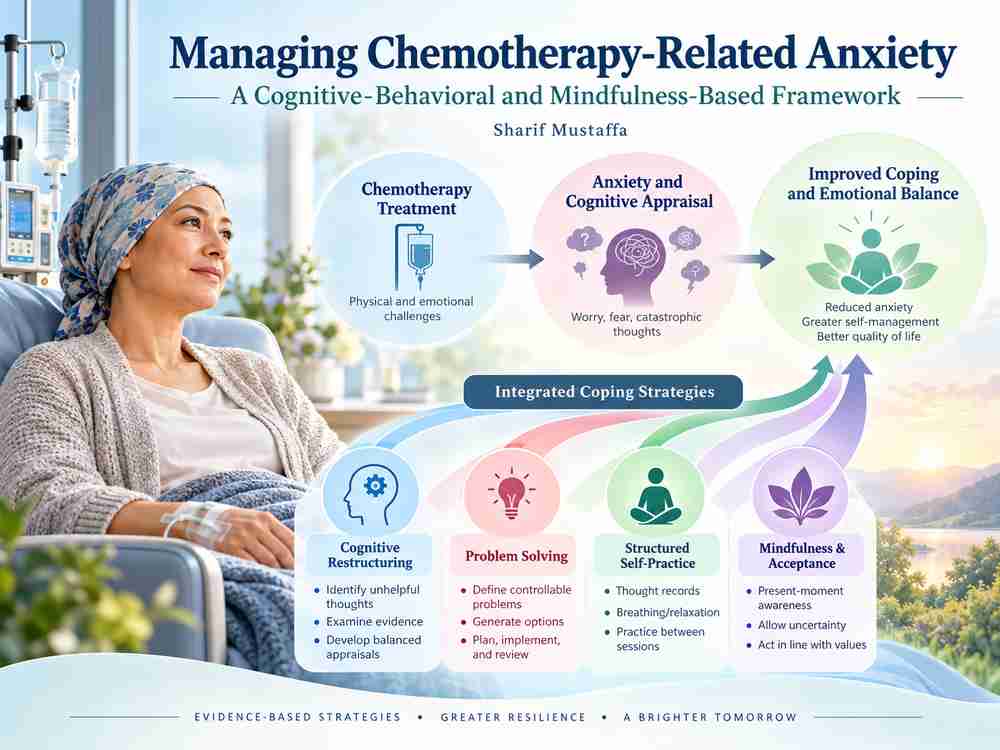
Chemotherapy can generate substantial anticipatory anxiety because patients may expect nausea, vomiting, fatigue, pain, loss of control, and disruption of family or occupational roles. These reactions are shaped not only by treatment-related physical effects but also by cognitive appraisal, previous experiences, information obtained from others, and the perceived ability to cope. This article presents an expanded brief counselling framework that integrates cognitive-behavioral methods with structured problem solving, self-practice, mindfulness, and acceptance-based strategies. The framework is designed for use before and during chemotherapy and emphasizes realistic cognitive reappraisal rather than simple positive thinking. It also incorporates distress screening, collaborative goal setting, practical coping plans, and referral when symptoms exceed the scope of brief counselling. Contemporary psycho-oncology guidance supports routine assessment of psychological distress and the use of evidence-based psychosocial interventions, including cognitive-behavioral and mindfulness-based approaches. The proposed framework is intended as a clinically practical model rather than as evidence of a newly tested intervention. Future research should evaluate its feasibility, cultural adaptability, and effects on anxiety, psychological flexibility, treatment engagement, and quality of life.
Downloads
References
Andersen, B. L., Lacchetti, C., Ashing, K., Berek, J. S., Berman, B. S., Bolte, S., Dizon, D. S., Given, B., Nekhlyudov, L., Pirl, W., Stanton, A. L., & Rowland, J. H. (2023). Management of anxiety and depression in adult survivors of cancer: ASCO guideline update. Journal of Clinical Oncology, 41(18), 3426–3453. https://doi.org/10.1200/JCO.23.00293
Carlson, L. E., Ismaila, N., Addington, E. L., Asher, G. N., Atreya, C., Balneaves, L. G., Bradt, J., ... Rowland, J. H. (2023). Integrative oncology care of symptoms of anxiety and depression in adults with cancer: Society for Integrative Oncology–ASCO guideline. Journal of Clinical Oncology, 41(28), 4562–4591. https://doi.org/10.1200/JCO.23.00857
Corey, G. (2011). Theory and practice of group counseling (8th ed.). Brooks/Cole, Cengage Learning.
Fann, J. R., Vanderlan, J., Brewer, B. W., Corbett, C., Keller, J., Lahijani, S., Niazi, S. K., Riba, M. B., Andersen, B., Atreya, C. E., Braun, I. I., Breitbart, W. S., Channa, Y., Farabelli, J., Fleishman, S., Garcia, S., Greenberg, D. B., Handzo, G. F., Horyna, A., ... Darlow, S. (2026). NCCN Guidelines® Insights: Distress management, Version 1.2026. Journal of the National Comprehensive Cancer Network, 24(4), Article e260018. https://doi.org/10.6004/jnccn.2026.0018
Gielissen, M. F. M., Verhagen, S., Witjes, F., & Bleijenberg, G. (2006). Effects of cognitive behavior therapy in severely fatigued disease-free cancer patients compared with patients waiting for cognitive behavior therapy: A randomized controlled trial. Journal of Clinical Oncology, 24(30), 4882–4887. https://doi.org/10.1200/JCO.2006.06.8270
Goedendorp, M. M., Peters, M. E. W. J., Gielissen, M. F. M., Witjes, J. A., Leer, J. W., Verhagen, C. A. H. H. V. M., & Bleijenberg, G. (2010). Is increasing physical activity necessary to diminish fatigue during cancer treatment? Comparing cognitive behavior therapy and a brief nursing intervention with usual care in a multicenter randomized controlled trial. The Oncologist, 15(10), 1122–1132. https://doi.org/10.1634/theoncologist.2010-0092
Jiang, X., Sun, J., Song, R., Wang, Y., Li, J., & Shi, R. (2024). Acceptance and commitment therapy reduces psychological distress in patients with cancer: A systematic review and meta-analysis of randomized controlled trials. Frontiers in Psychology, 14, 1253266. https://doi.org/10.3389/fpsyg.2023.1253266
Li, Z., Lei, D., Ting, L., Yao, R., Jing, W., & Na, M. (2024). The impact of mindfulness intervention on negative emotions and quality of life in malignant tumor patients: A systematic review and meta-analysis. Frontiers in Psychology, 15, 1443516. https://doi.org/10.3389/fpsyg.2024.1443516
Ma, X., Zhang, J., Zhong, W., Shu, C., Wang, F., Wen, J., Zhou, M., Sang, Y., Jiang, Y., & Liu, L. (2014). The diagnostic role of a short screening tool the Distress Thermometer: A meta-analysis. Supportive Care in Cancer, 22(7), 1741–1755. https://doi.org/10.1007/s00520-014-2143-1
Mustaffa, S., Musa, A. M., Abu, S., & Yusof, R. M. (2012). Effects of cognitive behavior approaches in anxiety for cancer patient undergone chemotherapy. International Journal of Fundamental Psychology and Social Sciences, 2(4), 70–73.
Reangsing, C., Punsuwun, S., & Wongsuraprakit, S. (2025). Effects of mindfulness-based interventions on patients with anxiety in cancer: A systematic review and meta-analysis. Journal of Integrative and Complementary Medicine, 31(12). https://doi.org/10.1089/jicm.2024.0943
Riba, M. B., Donovan, K. A., Andersen, B., Braun, I., Breitbart, W. S., Brewer, B. W., Buchmann, L. O., Clark, M. M., Collins, M., Corbett, C., Fleishman, S., Garcia, S., Greenberg, D. B., Handzo, G. F., Hoofring, L., Huang, C.-H., Lally, R., Martin, S., McGuffey, L., ... Darlow, S. D. (2019). Distress management, Version 3.2019, NCCN Clinical Practice Guidelines in Oncology. Journal of the National Comprehensive Cancer Network, 17(10), 1229–1249. https://doi.org/10.6004/jnccn.2019.0048
Spiegler, M. D., & Guevremont, D. C. (2010). Contemporary behavior therapy (5th ed.). Wadsworth, Cengage Learning.
Xia, W., Zheng, Y., Guo, D., Zhu, Y., & Tian, L. (2024). Effects of cognitive behavioral therapy on anxiety and depressive symptoms in advanced cancer patients: A meta-analysis. General Hospital Psychiatry, 87, 20–32. https://doi.org/10.1016/j.genhosppsych.2024.01.006
Published
How to Cite
Issue
Section
License
Copyright (c) 2026 Author

This work is licensed under a Creative Commons Attribution-NonCommercial 4.0 International License.